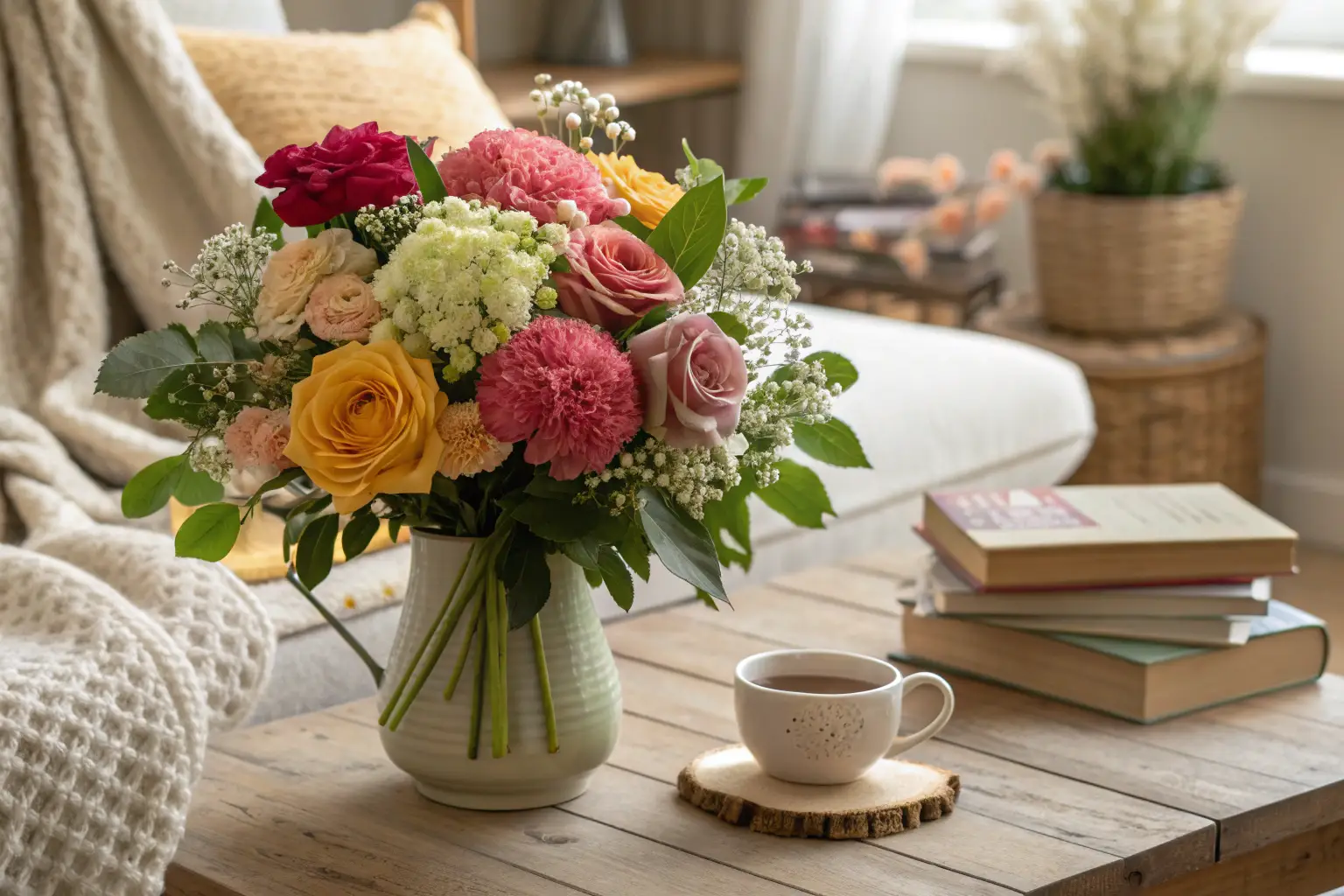

If you’ve ever put flowers on the table and thought, “Why does this look sad?” you’re not alone. Most home arrangements fail for one boring reason: they don’t have structure. The stems are fine. The vase is fine. But there’s no shape, no rhythm, and no plan for how the eye should move.
Thank you for reading this post, don't forget to subscribe!
This is for anyone who wants their home to feel cared for without turning flower arranging into a second job. Maybe you love fresh blooms but hate how fast they fade. Maybe faux flowers have burned you before and you’re tired of plastic shine. Either way, the goal here is simple: floral arrangement ideas for home that look natural, balanced, and a little bit expensive—without being fussy.
And yes, we’ll cover the questions people ask in real life: who makes the most realistic faux plants, whether Hobby Lobby or HomeGoods has good options, how long faux plants last, what trends look good now, and how to spot fake greenery that will scream “fake” from across the room.
Why most home arrangements look “off” (even with pretty flowers)
In real houses (not styled photo shoots), flowers sit next to keys, mail, lamps, kids’ stuff, and dinner prep. That means your arrangement has to hold up visually even when the room is busy. When it doesn’t, it usually comes down to one of these:
- Too few stems for the vase. The bouquet floats, gaps show, and it reads cheap.
- Everything is the same height. No movement. No focal point.
- The greenery is too shiny or too perfect. Real leaves have tiny flaws and varied tones.
- Wrong scale for the space. A tiny bud vase on a big dining table feels lost.
Once you fix structure and scale, your flowers start looking like they belong in your home, not like you set them down mid-task.
The “easy math” that makes flowers look right: 3:5, 3:5:8, and the golden ratio
The 3:5 rule for flowers
Think of this as a shortcut for proportion. You use three main heights:
- 3 parts (short)
- 5 parts (medium)
- 8 parts (tall)
Some people call it the 3:5:8 rule of flower arrangement because it’s a simple way to build a shape that feels natural. It also echoes patterns related to the Fibonacci sequence and the golden ratio, which show up all over nature. If you want the reference point, see Fibonacci numbers on Wikipedia: https://en.wikipedia.org/wiki/Fibonacci_number and the golden ratio here: https://en.wikipedia.org/wiki/Golden_ratio
The 3:5:8 rule (real example)
Say your vase is on a console table. Pick a tallest stem height you like—maybe 16 inches above the rim. Then build the rest around it:
- Tall group: ~16 inches (8)
- Medium group: ~10 inches (5)
- Short group: ~6 inches (3)
It doesn’t have to be perfect. It just needs to be different enough that the arrangement has a “lift” and a “base.”
The golden rule in floral design (the version you’ll use)
Don’t overthink the math. The most useful “golden rule” at home is this:
One focal point, supporting players, and breathing room.
A single hero bloom (or a cluster) + medium blooms + airy filler/greens. Leave a few intentional gaps so it doesn’t look like a tight ball.
Principles of floristry (and the 7 principles)
If you’ve heard people talk about “principles,” they mean the same things you notice when an arrangement looks balanced. The commonly taught 7 principles of floristry are:
- Balance (it shouldn’t feel like it will tip)
- Proportion (flowers to vase to table)
- Scale (arrangement size fits the room)
- Rhythm (your eye moves through it)
- Emphasis (a focal point)
- Harmony (colors and textures cooperate)
- Unity (it feels like one idea)
More background on floral design basics is nicely summarized here: https://en.wikipedia.org/wiki/Floral_design
How many flowers should be in a floral arrangement?
For a medium vase on a dining table, I get the best results with:
- 9–15 stems for a loose, airy look
- 18–30 stems for a fuller look (especially with grocery-store stems)
If your vase is wide, you need more stems or you need mechanics (we’ll get to that).
What does giving 7 flowers mean?
Meanings vary by culture and context, so don’t treat it like a universal code. In a lot of modern gifting, 7 flowers reads as “a thoughtful, intentional number,” not “I grabbed whatever was left.” If you want a deeper look at how flower symbolism shifts across time and place, Wikipedia’s overview is a fair starting point: https://en.wikipedia.org/wiki/Language_of_flowers
Step-by-step: how to make a beautiful flower arrangement at home
This is the method I use when I want flowers to look good from multiple angles, not just from the front.
What you’ll need
- Clean vase (soap residue shortens vase life)
- Sharp scissors or snips
- Fresh water
- Optional but helpful: floral tape, clear tape, or a pin frog/flower frog
If you’re working with fresh flowers, these care basics are backed by extension programs like Iowa State University’s cut flower care guidance: https://hortnews.extension.iastate.edu/cut-flowers
Step 1: Choose your “shape” before you cut
Pick one: airy and tall, round and low, or asymmetrical (my favorite for homes because it feels relaxed).
Step 2: Make a stem grid (if your vase is wide)
Lay tape across the top of the vase like a tic-tac-toe grid. This keeps stems from splaying. It’s the quickest fix for “my flowers fall apart.”
Step 3: Build the bones with greenery
Start with 3–5 stems of greens. Angle them outward. Let them create your silhouette.
Step 4: Add focal blooms in odd numbers
Odd numbers look more natural. Place 1–3 focal blooms slightly off-center, not perfectly in the middle.
Step 5: Add mid-layer flowers
These connect the focal blooms to the greens. Think of them as the “bridge.”
Step 6: Add airy filler last
Baby’s breath, waxflower, asters, or even a few delicate faux sprigs. This is where you create softness without crowding.
Step 7: Walk away, then adjust
I do one lap around the room and come back. If it looks heavy on one side, rotate a stem instead of adding more.
15 floral arrangement ideas for home that don’t look like everyone else’s

Each idea includes a real-life use case and a simple build plan. Mix real and faux as needed. That blend is a secret weapon when you want something that looks fresh but lasts.
1) The “keys-and-mail” entry arrangement (tough-love pretty)

Where it works: entry console, foyer shelf
Why it works: it holds its own next to clutter
Build:
- Green base (real eucalyptus or faux olive)
- 3 focal blooms (real lilies, faux peonies, or roses)
- 5 mid blooms (tulips, ranunculus)
- 8 airy stems (waxflower, faux berry sprigs)
Tip: Keep height above eye level only if it’s not blocking sightlines.
2) The low coffee-table bowl that still feels special

Where it works: living room
Why it works: you can talk over it
Build:
- Shallow bowl + pin frog or floral foam
- Short stems only: garden roses, ranunculus, anemones
- Add 2 textures: something soft + something crisp (like seeded eucalyptus)
Personal note: I stopped putting tall flowers on coffee tables after one too many “I can’t see you” dinners with friends.
3) One-ingredient flowers, clustered like you meant it

Where it works: kitchen island, mantel
Why it works: looks modern and confident
Build:
- 10–20 stems of one flower (tulips, carnations, roses)
- Trim at slightly different heights for movement
This is also the easiest way to make grocery flowers look high-end.
4) The “three bud vases” trick (fast, not fussy)

Where it works: bathroom counter, nightstand, open shelving
Why it works: you don’t need many stems
Build:
- 3 small vases
- Put one type of flower in each
- Keep heights in the 3:5:8 family (short/medium/tall)
5) The kitchen windowsill herb-and-bloom mix

Where it works: near natural light
Why it works: it feels lived-in, not styled
Build:
- Small vase with 3–5 blooms
- Add a few herb clippings (rosemary, mint)
Fresh herbs read “real” instantly, even if you slip in a couple faux stems.
6) The dining table runner, but done with small moments

Where it works: long dining table
Why it works: you can scale it up or down
Build:
- 5–7 small vessels (jars, bud vases, small cylinders)
- Repeat two flowers and one greenery across all vases
- Keep each tiny arrangement simple (3–5 stems)
7) The “grocery bouquet upgrade” in 6 minutes

Where it works: anywhere you need a win
Why it works: it fixes the tight, round grocery look
Build:
- Buy 1 mixed bouquet + 1 bunch of greens
- Unwrap, remove the lowest leaves
- Split into two vases (one tall, one short)
- Add greens first, then tuck flowers in
8) The minimalist ikebana-inspired moment (no special training)

Where it works: side table, desk
Why it works: it’s calm
Build:
- 1 branch (real or faux)
- 1 focal bloom
- 1 supporting stem
Use negative space on purpose.
If you want a background read on ikebana: https://en.wikipedia.org/wiki/Ikebana
9) The “permanent porch” arrangement for your front door

Where it works: in front of a house, covered porch, entry pots
Why it works: sun and heat destroy fresh flowers fast outdoors, so faux wins here
Build (outdoor faux):
- Use UV-rated faux stems when possible
- Anchor with rocks + a foam block inside the planter
- Use sturdy greens (faux boxwood, faux eucalyptus)
- Add seasonal color stems you can swap
How to arrange flowers in front of a house: keep the tallest stems toward the back (or center if viewable from all sides), medium around, then trailing elements at the edge.
10) A bathroom arrangement that doesn’t mold or droop

Where it works: bathrooms with low light
Why it works: fresh flowers die fast here
Build (faux-forward):
- Small faux eucalyptus + 1–2 faux white blooms
- Choose matte, soft-touch petals
- Dust monthly (it matters more than people admit)
11) The bedside “quiet luxury” stem count

Where it works: nightstand
Why it works: small scale, big payoff
Build:
- 3 stems only: one focal, one supporting, one airy
- Keep scent gentle if you’re sensitive (skip heavy lilies)
12) The “bookcase planter” with faux greens and real water tricks

Where it works: shelves, offices
Why it works: plants bring depth to flat shelving
Build:
- Faux trailing vine (but choose one with varied leaf size)
- Real terracotta pot
- Top with preserved moss or real pebbles
13) A mantel arrangement that doesn’t look like a wedding centerpiece

Where it works: mantel, credenza
Why it works: asymmetry feels homey
Build:
- Start with a long green garland (real or faux)
- Create one heavier flower “moment” on one side
- Let the other side taper with greens and a few small blooms
20 Plant Decor Ideas for Indian Living Rooms | Indoor Styling Guide
14) The “dried + fresh” arrangement that lasts longer

Where it works: dining table, kitchen
Why it works: you get longevity without going full faux
Build:
- Dried base: pampas, bunny tails, dried palm
- Fresh accent: 3–5 stems of something seasonal
If you’re curious about dried flower history and use: https://en.wikipedia.org/wiki/Dried_flower
15) The living-room “real tree, faux support” combo

Where it works: corners, reading nooks
Why it works: you get the life of a real plant with the reliability of faux styling
Build:
- One real indoor plant (like a pothos or snake plant)
- One faux tree in a big pot for height
- Use matching planters so it reads intentional
For basic indoor plant guidance, the Royal Horticultural Society has solid, practical info: https://www.rhs.org.uk/plants/indoor-plants
Faux vs real: how to choose, so nothing looks cheap
Do artificial plants look cheap?
They look cheap when they’re shiny, flat-colored, or the leaves are the same size and angle. Real plants have small irregularities. Good faux copies that.
What to look for when buying fake plants
Use this checklist in-store:
- Finish: matte or satin, not glossy
- Color: at least 2–3 tones per leaf (new growth should be lighter)
- Veining: subtle texture makes a big difference
- Stems: wired stems you can bend into natural positions
- Imperfection: tiny spots, uneven edges, slight curl
- Weight: good faux often has heavier stems and better fabric
What kind of artificial flowers look the most realistic?
In my experience, these fool people most often:
- Orchids (when petals are matte and slightly translucent)
- Peonies (higher-end ones with layered petals)
- Tulips (soft-touch latex styles)
- Hydrangeas (when color variation is strong and not neon)
How to make fake plants look more realistic (the hands-on list)
This is where most people level up fast:
- Re-pot them. The thin black nursery pot screams “store shelf.” Put it into a heavier pot.
- Add weight. Fill the bottom with stones or sand, then top with moss.
- Bend every stem. Nature doesn’t grow in perfect symmetry.
- Kill the shine. If a leaf is glossy, try a very light matte clear spray on a test leaf first.
- Mix in one real element. Even one real branch clipped from outside makes the whole thing read more believable.
- Dust them. Dust is what makes faux look fake faster than anything else.
What holds fake flowers in place?
At home, the easiest anchors are:
- Floral foam blocks (dry foam for faux, wet foam for fresh)
- Pin frogs / flower frogs (great for low arrangements)
- Chicken wire stuffed into a vase (classic florist trick)
- Rocks + hot glue (for permanent faux in a pot)
How long do faux plants last? How long do artificial plants last?
Indoors, a good-quality faux plant can look good for 5–10 years or longer if it’s kept out of harsh sun and cleaned. The thing that ruins them fastest is UV light fading and turning greens dull. Near a bright window is fine; direct sun all day is rough.
So if you’re asking:
- How long do faux plants last inside? Usually many years, if you dust and avoid intense sun.
What’s trending in artificial plants right now (and what looks dated)
What are the latest trends in artificial plants?
What I’m seeing in real homes and retail displays:
- Bigger statement trees (olive, ficus, rubber tree)
- More natural, softer greens (less emerald, more dusty tones)
- “Real potting” finishes (moss, soil-look toppers, textured bark)
- Fewer tiny trinket plants and more intentional, scaled pieces
- Mixed botanicals (a little dried, a little faux, a little real)
Are fake plants out of style in 2026 and the next season?
No. What’s out of style is obvious faux: shiny leaves, tiny plastic ferns, and arrangements that look like they came pre-glued from a discount aisle. The direction now is realism and restraint. Fewer faux pieces, chosen better, styled like real plants.
Are artificial flower arrangements out of style?
Only the ones that look mass-produced and overly symmetrical. The “in” look is garden-style looseness and imperfect movement.
What flower arrangements are trending?
- Asymmetrical garden arrangements
- Clusters of bud vases
- Monochrome palettes (all white, all blush, all yellow)
- Dried + fresh mixes
- Minimal ikebana-inspired stems
Store questions people ask (with straight answers)
Does Hobby Lobby have faux plants?
Yes. Their faux selection is broad and often affordable. You’ll want to be picky and look for matte leaves and wired stems. Start at their site here: https://www.hobbylobby.com/
Does HomeGoods have artificial plants?
Yes, and it’s hit-or-miss in the best way. Great for pots and occasional gems in faux stems. Inventory varies by store. Main site: https://www.homegoods.com/
Does Home Depot sell plants online?
Yes. They sell live plants and faux décor online. For live plants, check ship dates and return rules. Start here: https://www.homedepot.com/
Do IKEA fake plants look real?
Some do, especially the simpler greens. The best-looking ones are usually the ones with fewer “details” to get wrong. IKEA site: https://www.ikea.com/
Are Pottery Barn faux flowers good?
Many are, especially their larger stems and seasonal branches. They tend to get the scale right, which helps realism. Pottery Barn site: https://www.potterybarn.com/
Who makes the most realistic faux plants (and the most real-looking artificial tree)?
There’s no single winner for every category, but here are brands that repeatedly show up in well-styled homes:
- Afloral for high-end faux stems and arrangements: https://www.afloral.com/
- Nearly Natural for faux trees and big greenery: https://www.nearlynatural.com/
- Pottery Barn for realistic scale and home-friendly styling: https://www.potterybarn.com/
- IKEA for affordable basics that can look good when re-potted: https://www.ikea.com/
- Balsam Hill for premium faux trees (best known for seasonal trees, but quality is strong): https://www.balsamhill.com/
What is the most real-looking artificial tree?
The most convincing ones tend to be faux olive trees and faux ficus trees with:
- layered branching
- varied leaf size
- a believable trunk texture
- and a pot that doesn’t look like plastic
If the trunk looks like a toy, nothing else will save it.
Real flowers: why Trader Joe’s flowers are so cheap, and when to order online
Why are Trader Joe’s flowers so cheap?
A few reasons tend to stack:
- They buy in high volume.
- They keep options tight (fewer varieties than a full florist).
- Bouquets are designed for fast turnover.
You can browse their brand info here: https://www.traderjoes.com/home
What is the best company to order flowers from?
It depends on what “best” means to you:
- If you want a classic nationwide delivery network, 1-800-Flowers is well-known: https://www.1800flowers.com/
- If you want handcrafted florist delivery, FTD is a long-running network: https://www.ftd.com/
- If you want to send plants instead of cut flowers, The Sill is popular for houseplants: https://www.thesill.com/
Fresh flowers shipped long distance can be stunning, but they can also arrive tired. When I need flowers to look their best for a dinner, I still prefer buying locally the day before and conditioning them overnight.
Is it cheaper to buy real or fake flowers?
If you buy fresh flowers weekly, faux can be cheaper over time. If you buy fresh flowers a few times a year, fresh is often the better value because it looks and smells unbeatable.
A practical way to decide:
- Faux wins for low-light rooms, busy schedules, and “always pretty” spots.
- Fresh wins for hosting, scent, and that alive feeling.
Buying plants online: best websites, legit checks, and pricing reality
What are the best websites for buying plants?
For live plants, these are well-known in the U.S.:
- https://www.thesill.com/
- https://www.fast-growing-trees.com/ (trees and outdoor plants)
- https://www.homedepot.com/ (broad selection)
Which site is best for buying plants online?
Pick based on what you’re buying:
- Houseplants: The Sill
- Outdoor trees/shrubs: Fast Growing Trees
- Broad, price-competitive options: Home Depot
How can I tell if an online plant store is legit?
A quick checklist I use:
- Clear return policy and live-arrival guarantee (written, not vague)
- Real customer reviews on third-party platforms
- Physical address and customer service contact
- Secure checkout
- No “too good to be true” pricing on rare plants
For general online shopping safety guidance, the FTC has good tips: https://consumer.ftc.gov/topics/online-shopping
Is it cheaper to order plants online?
Sometimes. Online stores run deals, but shipping and winter packaging can add cost. Also, local garden centers often have sturdier plants because they’ve already adjusted to your region.
Does it matter where you buy plants from?
Yes. Healthy roots and good packing matter more than the photo. A cheap plant that arrives stressed can become an expensive replacement.
Feng shui and faux flowers: is it okay to have artificial flowers at home?
What does feng shui say about fake flowers?
Feng shui is interpreted in different ways, but the general idea is that living plants represent growth and vitality. Faux can be fine if it’s clean, beautiful, and not dusty or broken. A simple reference on feng shui basics: https://en.wikipedia.org/wiki/Feng_shui
Is it okay to have artificial flowers at home?
Yes—if they’re styled thoughtfully and maintained. Dusty faux stems give off a neglected feeling, and that’s what people react to.
Missteps I see in real homes (and quick fixes)
- Too-small arrangements on big surfaces → Use multiple small vases or go taller with branches.
- Shiny faux leaves → Choose matte stems, or test a matte spray on one leaf.
- All blooms, no greens → Add 3–5 stems of greenery to create shape.
- Perfect symmetry → Shift the focal point off-center. Bend stems.
- Wrong vase neck (too wide) → Tape grid at the top, or use a frog.
- Faux stems sitting in an empty pot → Add stones + moss topper for weight and realism.
(These bullets are formatted so you can lift them into structured data if you want.)
Quick FAQ (clear answers to your exact questions)
Do artificial plants look cheap?
They do when they’re glossy, flat-colored, and perfectly uniform. Matte finish, varied tones, and a better pot fix most of it.
How do you make artificial plants look more realistic?
Re-pot, add weight, bend stems, top with moss/pebbles, remove shine, and dust regularly.
What are fake flower arrangements called?
You’ll see “faux florals,” “artificial arrangements,” and “silk flower arrangements” (even when they’re not silk).
Are fake flowers tacky or stylish? Are fake flowers tacky in a home?
They’re stylish when they’re realistic and styled with restraint. They look tacky when they’re shiny, crowded, or obviously mass-produced.
What are the best fake indoor plants?
Faux olive trees, faux ficus, faux snake plant, and quality faux pothos/trailing vines tend to look convincing because the forms are familiar and easy to style.
What is the prettiest indoor plant?
Personal pick: a healthy pothos or a rubber plant looks great in most homes with little effort. Trend-wise, people still love statement trees.
What indoor plants are trending now?
Statement trees (olive/ficus), climbing plants (pothos), and sculptural plants (snake plant). For a broad reference database on houseplants, see https://www.missouribotanicalgarden.org/plantfinder/plantfindersearch.aspx
Where is the best place to put plants?
Where they match the light and where you’ll see them daily: near windows for live plants, and in low-light “dead zones” for faux.
What are the 10 most popular flowers?
Roses, tulips, lilies, orchids, carnations, daisies, sunflowers, hydrangeas, peonies, chrysanthemums.
What is the number one prettiest flower?
It’s subjective, but roses are the classic pick for “most beautiful” across a lot of cultures. If you want rose-specific history and standards, start with the American Rose Society: https://www.rose.org/
What are the four rules of a flower (simple home version)?
Clean vase, clean water, fresh cut stems, and a clear shape (tall/medium/short).
What is the golden ratio in flowers?
A proportion guideline seen in nature that often looks pleasing in design. In flowers, it shows up as balanced height groupings and spacing, not strict measuring. Reference: https://en.wikipedia.org/wiki/Golden_ratio
How to arrange flowers in front of a house?
Use taller stems toward the back/center, medium around, trailing at the edge, and anchor everything so wind won’t loosen it.
A quick next step (so you can use this today)
Pick one spot in your home that annoys you because it looks empty—entry table, kitchen counter, or bathroom. Choose one of the 15 ideas above. Then follow the step-by-step method once. The second time is faster, and by the third time you’ll start seeing shape and proportion without thinking.
If you want, tell me which room you’re styling (and whether you want fresh, faux, or a mix). I’ll recommend a specific stem recipe with counts, colors, and vase shape that fits your space.
create an article of 3000-word, SEO-optimized, pure Humanize 1000%, non generic fully human-written that focuses on the topic “15 Floral arrangement ideas for home that” with following Questions: Who makes the most realistic faux plants?
What to look for when buying fake plants?
Does Hobby Lobby have faux plants?
Do artificial plants look cheap?
How long do faux plants last?
How long do artificial plants last?
What are the latest trends in artificial plants?
What is the most real-looking artificial tree?
Are fake plants out of style in 2025?
Are fake plants out of style in 2025/2026?
How to make fake plants look more realistic?
How do you make artificial plants look more realistic?
Why are Trader Joe’s flowers so cheap?
What is the 3:5:8 rule for flowers?
What is the 3:5 rule for flowers?
What is the 3:5:8 rule of flower arrangement?
What is the golden rule in floral design?
What is the golden ratio in flowers?
What are the principles of floristry?
What are the 7 principles of floristry?
How many flowers should be in a floral arrangement?
What does giving 7 flowers mean?
Are fake flowers tacky or stylish?
Are fake flowers tacky in a home?
Are Pottery Barn faux flowers good?
What kind of artificial flowers look the most realistic?
What are the most realistic looking fake flowers?
What is the best company to order flowers from?
What is the number one prettiest flower?
How do you make fake flowers look more realistic?
Is it cheaper to buy real or fake flowers?
What are the best websites for buying plants?
Which site is best for buying plants online?
How can I tell if an online plant store is legit?
Does Home Depot sell plants online?
Is it cheaper to order plants online?
Does it matter where you buy plants from?
Do Ikea fake plants look real?
Do Ikea faux plants look realistic?
What are the best fake indoor plants?
What is the prettiest indoor plant?
What indoor plants are trending now?
Where is the best place to put plants?
How long do fake plants last inside?
What are fake flower arrangements called?
What holds fake flowers in place?
Are artificial flower arrangements out of style?
What flower arrangements are trending?
What does feng shui say about fake flowers?
Is it okay to have artificial flowers at home?
What are the 10 most popular flowers?
What are the four rules of a flower?
How to arrange flowers in front of a house?
How to make a beautiful flower arrangement at home?
Does HomeGoods have artificial plants? Write in long words and big paragraphs with depth catchy and attractive talk, Avoid complex words, fluff, and filler Do not use the word “ultimate” Write for 2026 SEO standards, not outdated tactics Content must feel human, practical, and experience-based Content Requirements Focus & Intent Address one specific problem Clearly state: Who this is for What problem it solves When / why this solution works Content Depth (Required Sections) Include all of the following naturally: Practical advice (actionable, not theory) Step-by-step guidance Real-world examples Use-cases and useful tips Real scenarios Personal observation (human insight) Specific recommendations (not generic tips) Common mistakes (schema-ready) SEO & Trust Signals Include clickable external links inside paragraphs (link only to authoritative sources like Google, Wikipedia, major brands, research sites) Maintain consistent niche authority throughout the article No keyword stuffing No robotic or AI-sounding language Deliverables (Must Be Included) Along with the blog post, also provide: A. SEO Data Primary keyword Secondary keywords SEO-optimized meta title SEO-optimized meta description Suggested SEO-friendly URL slug B. Structure A detailed outline of the blog post (H1, H2, H3) Clear logical flow (problem → solution → examples → steps → mistakes → conclusion) C. Writing Instructions General instructions used to write this post (so the same quality can be repeated) Style Rules Summary One problem only Simple words Short lines Real help pure Human tone with depth No fluff No “ultimate” Value first, SEO second Final Reminder Google trusts content that actually helps people.add more xternal links Write like an expert who has seen the problem in real life, not like a content farm.Also Change the title and make it more catchy..and avoid words conclusion,finalthoughts,who is this guide for,common mistakes,2025 and actually.Set the Voice Before the Words “Write the text in a voice that is clear, confident, and conversational. Use short sentences, natural rhythm, and avoid buzzwords or clichés.”Match a Real Person’s Writing Style “Rewrite the text as if it were written by a real person. Keep it natural, specific, and grounded in real-world language.”Control Tone With Precision “Rewrite the message for the audience: . Specify tone as warm, direct, intelligent, and human. Avoid robotic phrasing.”Improve Flow Without Changing Meaning “Edit the text to improve flow, clarity, and sentence rhythm while preserving my original meaning and intent.” Make It Sound Like Spoken Language “Rewrite the text so it reads like something someone would actually say out loud. Use contractions, varied sentence length, and natural phrasing.”Remove AI-Sounding Patterns “Rewrite the text and explicitly remove common AI patterns like repetition, generic transitions, and overly formal phrasing.”Polish, Don’t Overwrite “Lightly edit the text to sound clean, confident, and natural. Do not add fluff. Do not change my voice. also target the main keywords.


