
Thank you for reading this post, don't forget to subscribe!
This guide fixes that. Twenty proven wall hanging ideas. Real techniques from people who actually decorate bedrooms for a living. No recycled Pinterest lists. No vague suggestions like “add art” without telling you how. Just specific, doable approaches that work in 2026 and beyond.
Why Empty Walls Drain Your Energy
Before we hang anything, understand what bare walls do to a space. Research from the University of Texas on environmental psychology shows that visually sparse environments increase cortisol levels. Your brain registers emptiness as unfinished business. It creates subtle stress.
Your bedroom should do the opposite. It should lower your heart rate. Signal safety. Wrap around you at the end of hard days.
The right wall hangings create that container. They absorb sound. Add texture. Give your eyes places to rest that aren’t screens. Most importantly, they make the room feel considered—like someone who cares lives here.
The Rules That Actually Matter
Decorating rules confuse everyone. Too many numbers. Too many fractions. Let’s clear the noise.
The Rule of Three
Three items grouped together create visual balance. Not two (feels accidental). Not four (feels crowded). Three has rhythm. Think of it like a sentence with three beats. Subject, verb, object. Beginning, middle, end.
Apply this by hanging three similar pieces in a row. Or one large piece flanked by two smaller ones. Or three shelves at staggered heights. The specific execution matters less than the odd number creating energy.
The 2/3 Rule for Wall Art
Your artwork should cover roughly two-thirds of the wall space above furniture. Above a queen bed (60 inches wide)? Your art or grouping should span about 40 inches. Too small looks like you couldn’t commit. Too large overwhelms.
Measure your furniture width. Multiply by 0.66. That’s your target span for whatever you hang.
The 3-5-7 Rule
When arranging multiple pieces, use odd numbers. Three for small walls. Five for medium. Seven for large expanses. Odd numbers force your eye to move. Even numbers let your eye rest in the middle and stop looking.
The 60-30-10 Rule for Bedrooms
This governs color distribution. Sixty percent dominant color (walls, large furniture). Thirty percent secondary color (bedding, curtains). Ten percent accent (your wall hangings). Your art and decor become the punctuation. The exclamation point that makes the room memorable.
The 70/30 Rule in Art
Seventy percent of your wall art should share a cohesive element—color palette, frame style, subject matter. Thirty percent can break the pattern. This prevents matchy-matchy hotel room vibes while maintaining intentionality.
What to Hang: 20 Specific Ideas
1. Oversized Woven Tapestries

Fabric absorbs sound better than hard surfaces. In bedrooms, this matters. You want quiet. A large woven piece—think 4×6 feet or bigger—adds softness that paint can’t touch.
Look for textile artists on Etsy or source vintage pieces from estate sales. Macramé had its moment. Now we’re seeing broader weaves, natural dyes, and irregular edges that feel handmade because they are.
Hang these with a wooden dowel slipped through a pocket at the top. Or use clip rings that let the fabric drape naturally. Avoid stretching it tight like a canvas. The slight sag is part of the appeal.
2. Curated Gallery Walls That Tell Stories

Not random frames. Stories. Your grandmother’s pressed flowers next to a photograph from your first apartment. A concert ticket stub floated in a small frame beside a charcoal sketch you bought from a street artist in Lisbon.
The mistake everyone makes: buying matching frames first. Don’t. Collect pieces that matter. Then find frames that relate them—similar wood tones, or all black, or mixed metals that share a finish quality.
Start with your largest piece slightly off-center. Build outward in a loose rectangle, not a rigid grid. Pieces should be 2-3 inches apart. Close enough to feel connected. Far enough to breathe.
3. Floating Shelves With Intentional Objects

Shelves aren’t storage. They’re display. In bedrooms, keep them sparse. Three objects per shelf maximum. A small sculpture. A stack of two books with a stone on top. A single bud vase.
The IKEA LACK floating shelf works for budget setups. For something weightier, try solid oak from Rejuvenation. Install with wall anchors rated for double your expected weight. Sagging shelves ruin the whole effect.
Stagger heights if using multiple shelves. The top at 72 inches, middle at 60, bottom at 48 creates a cascading line that draws the eye down toward your bed.
4. Architectural Salvage as Art

Old window frames. Reclaimed barn doors. Wrought iron grilles from demolished buildings. These carry history that new objects can’t manufacture.
Source from Architectural Antiques or local salvage yards. Clean thoroughly. Seal if needed. Hang with heavy-duty French cleats for anything over 20 pounds.
A single large window frame, glass removed, becomes a frame for your wall color. Or stretch linen across the opening for a translucent glow when backlit by bedside lamps.
5. Living Wall Installations

Plants in bedrooms improve air quality and reduce anxiety, according to NASA research on indoor plants. Vertical gardens take this upward.
Use modular systems like WallyGro pockets for beginners. Mount on walls that get indirect light. Choose low-maintenance varieties: pothos, philodendron, snake plants. Mist rather than soak to prevent wall damage.
The living element changes your room daily. New growth. Shifting shadows. It’s the opposite of static art, and that movement keeps spaces feeling alive.
6. Sculptural Metal Pieces

Wrought iron, brass, or copper wall sculptures add dimension that flat art lacks. They cast interesting shadows that shift throughout the day. In evening light, they become almost kinetic.
Look for mid-century modern pieces at estate sales, or contemporary artists working in metal. 1stDibs carries investment-level pieces. For accessible options, CB2 and West Elm rotate sculptural collections seasonally.
Hang these where they’ll catch both natural and artificial light. The interplay of shadow and reflection multiplies their presence.
7. Textile Art Beyond Tapestries

Quilts. Embroidery. Vintage saris stretched in frames. These carry cultural weight and textile warmth that printed canvas can’t match.
My neighbor hung her great-aunt’s unfinished quilt top—just the pieced top layer, never quilted—in a plexiglass frame. The raw edges, the pencil marks where she planned stitching, the fabric choices from 1950s feed sacks. It’s a portrait of a person she never met, and it’s the most compelling bedroom art I’ve seen.
Source from family attics, estate sales, or eBay vintage sections. Frame with UV-protective glass to prevent fading.
8. Mirrors That Expand and Reflect

Mirrors double visual space. In small bedrooms, they’re essential. But placement matters enormously.
Never hang a mirror where it reflects your bed directly. Feng shui practitioners warn this creates restless energy. Practically, waking to your own reflection at 3 AM is disorienting.
Instead, position mirrors to reflect windows (bringing in more light) or interesting architectural details. A large round mirror above a dresser. A tall narrow mirror in a corner to create depth illusion.
Frame choices set tone. Thin metal frames feel modern. Wide wood frames feel grounded. Ornate gilt frames feel romantic. Match to your bedroom’s emotional goal.
9. Shadow Boxes With Deep Narrative

Standard frames are flat. Shadow boxes have depth—usually 2-4 inches—to display dimensional objects.
A child’s first shoes. A collection of feathers from meaningful hikes. Vintage sewing notions from your grandmother’s tin. These become museum-quality displays of personal history.
Arrange with intention. Heavier items low, lighter high. Odd numbers of objects. Negative space that lets each piece claim attention. Michaels and Joann stock basic shadow boxes; custom framers can build deeper versions for specific objects.
10. Hand-Painted Murals (Yes, You Can)

Not everyone can afford a muralist. But everyone can apply paint to walls in ways that read as intentional rather than amateur.
The trick: limit your palette. Two colors maximum. Use painter’s tape to create geometric sections. Or freehand a simple botanical silhouette in a single color slightly darker than your wall.
For inspiration, study Farrow & Ball’s historical patterns. Their simplified florals and stripes translate well to DIY execution. Practice on poster board first. Live with the practice piece for a week before committing to walls.
11. Vintage Maps and Charts

Old maps carry romance. Navigation charts from decommissioned ships. Topographical surveys of places you’ve lived. Constellation maps from 19th-century observatories.
These read as intellectual without being pretentious. They add color without demanding attention. And they age beautifully—foxing and wear become character rather than damage.
Source from David Rumsey Map Collection for high-resolution downloads you can print large. Or hunt original prints at antique fairs. Frame simply; the map itself should dominate.
12. Ceramic and Clay Wall Pieces

Three-dimensional ceramics break up flat wall planes. Plates in graduated sizes. Sculptural tiles arranged in grids. Single large vessels mounted as focal points.
The Ceramic School offers directories of ceramic artists by region. Or explore local pottery studios—many artists create wall-specific pieces that never appear in shops.
Hang plates with invisible disc hangers, not wire springs that show. For sculptural pieces, use floating shelves or specialized wall mounts that grip without visible hardware.
13. Light-Based Installations

Neon signs have evolved beyond bar decor. Contemporary artists work in LED, fiber optics, and programmable light sequences that shift with time of day.
A single word in warm white neon above a headboard. A constellation map in pinprick LED lights. These become nightlights, mood setters, and art simultaneously.
Custom Neon and similar shops make bespoke pieces accessible. For DIY approaches, Philips Hue light strips behind floating shelves create indirect glow without visible fixtures.
14. Pressed Botanical Collections

Dried flowers and leaves preserve moments. Your wedding bouquet. Ferns from a transformative hike. Eucalyptus that scented your first apartment.
Press in heavy books for 2-3 weeks, then arrange between glass in floating frames. Or use specialized plant presses for faster, flatter results. The New York Botanical Garden offers detailed pressing guides.
Arrange by color gradient, or by collection location, or by plant family. Label with small tags if you’re scientifically inclined. Leave mysterious if you prefer poetry to taxonomy.
15. Acoustic Panels as Design Elements

Bedrooms need sound management, especially in apartments with shared walls. Acoustic panels don’t have to look institutional.
Companies like Acoustical Solutions offer fabric-wrapped panels in colors and textures that read as intentional design. Arrange in geometric patterns. Or commission custom-printed panels with personal photographs.
These improve sleep quality by absorbing street noise and partner snoring. They also eliminate the echo that makes empty bedrooms feel cold.
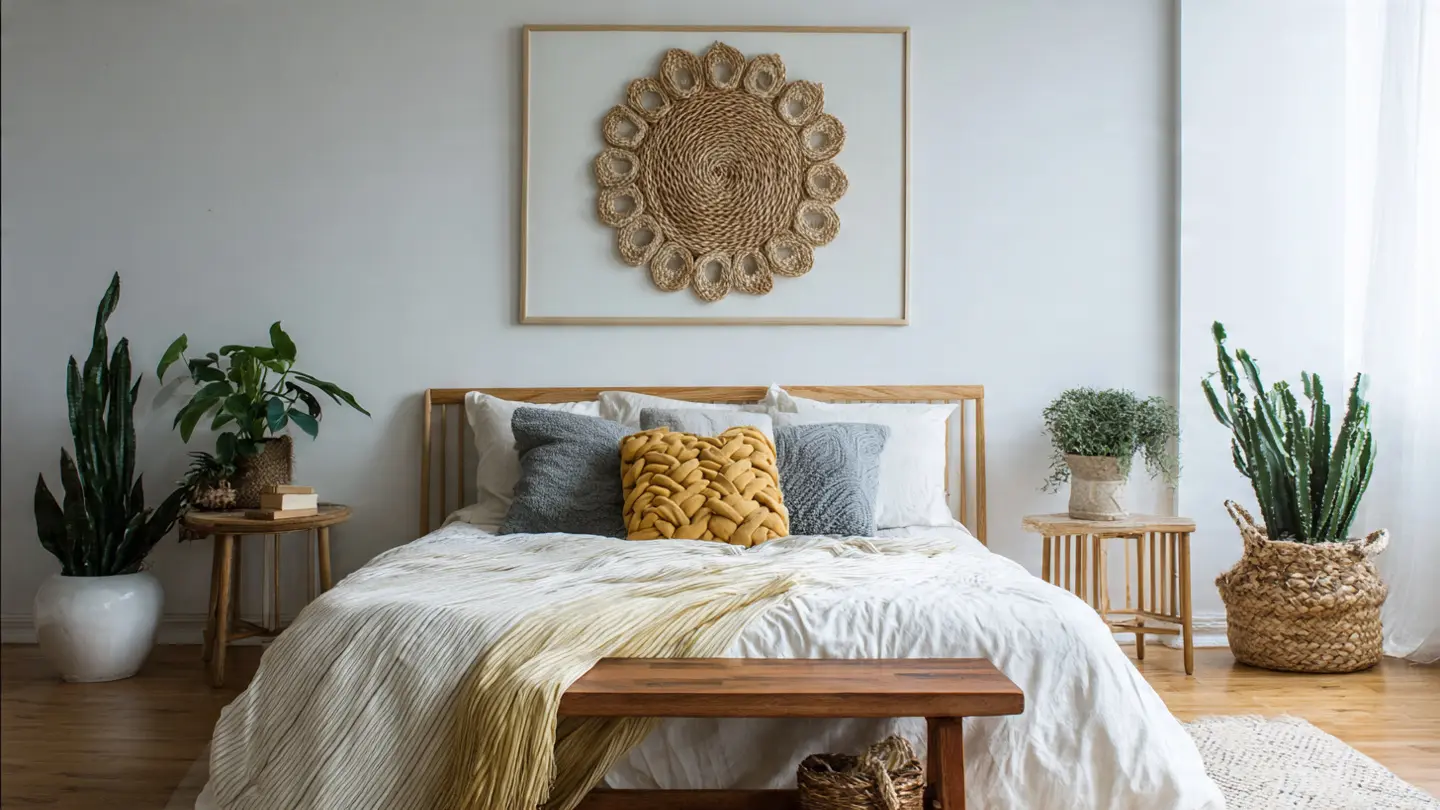
16. Woven Baskets in Relief

African grain baskets. Native American coil baskets. Contemporary woven wall sculptures. These add texture that flat art can’t achieve.
Hang in tight clusters of odd numbers—five, seven, nine. Vary sizes dramatically within the group. Keep colors in the same family (all naturals, or all black, or all indigo-dyed) to prevent visual chaos.
Source from fair-trade organizations like Ten Thousand Villages or directly from artisan collectives. Each piece carries provenance that mass-produced decor lacks.
17. Typography With Personal Meaning

Words on walls polarize people. Done poorly, they’re motivational-poster cringe. Done well, they anchor a room’s emotional intention.
The difference: specificity. Not “Live Laugh Love.” Instead, a line from your grandmother’s favorite poem. The coordinates of where you met your partner. A word in your heritage language that has no direct translation.
Commission from lettering artists on Instagram or Dribbble. Or use your own handwriting, scanned and enlarged. The personal connection transforms generic decoration into meaningful marker.
18. Fabric-Covered Canvas Panels

For large walls without large-art budgets, stretch fabric over artist canvas frames. Linen, velvet, vintage kimono silk—any textile with visual weight becomes instant art.
This solves the “what to put on a big empty wall” problem for under $100. Three 24×36 panels in coordinating fabrics fill a wall above a king bed. Five smaller panels create rhythm in narrow spaces.
Staple fabric tightly to canvas backs. Iron first for crisp results. These are lightweight, easy to rearrange, and simple to update when you want change.
19. Found Object Assemblages

Driftwood arranged in organic shapes. Rusted tools from family farms. Sea glass sorted by color gradient. These cost nothing but time and attention.
The art is in the arrangement. Spend hours moving pieces. Photograph options. Live with trials before finalizing. Mount on painted plywood backings, or directly to wall with appropriate anchors.
This approach works especially well in coastal, farmhouse, or industrial-style bedrooms where “perfect” would feel wrong.
20. Digital Frames With Curated Rotation

Digital frames evolved past clunky slideshows. Aura and similar brands offer museum-quality displays that show single images for days, not seconds. Matting options make digital files look like physical prints.
Curate intentionally. A season of images. A specific trip. Portraits of people you love, shown large enough to feel present. The ability to update without new frames means your walls can reflect your current life, not just past phases.
Feng Shui Considerations for Bedroom Walls
Traditional Chinese practice offers specific guidance on what belongs in sleep spaces. Whether you follow feng shui literally or treat it as design psychology, the principles create restful environments.
What to Hang for Positive Energy
- Pairs of objects (two candles, two pillows represented in art) support partnership
- Landscapes with gentle, not crashing, water
- Floral imagery with soft, rounded shapes
- Art that depicts what you want to invite into your life
What to Avoid
- Single figures (suggests isolation)
- Violent or chaotic imagery
- Water features that actually flow (too active for sleep spaces)
- Family photos in direct view of the bed (subconscious processing of their issues)
- Mirrors reflecting the bed
The Feng Shui Society offers detailed bedroom guidance, though interpretations vary by school.
Activating Wealth Corners
In feng shui’s bagua map, the far left corner from your bedroom door represents prosperity. Purple, green, and gold colors activate this area. Living plants (especially jade or money trees). Art depicting abundance—fruit, flowing water, flourishing gardens.
This isn’t magical thinking. It’s environmental psychology. Surrounding yourself with imagery of growth and plenty shifts your mindset toward opportunity.
Common Picture Hanging Mistakes (And How to Avoid Them)
I’ve made all of these. So has everyone who decorates.
Hanging too high. Art should relate to human scale, not ceiling height. Center pieces at 57-60 inches from floor—eye level for average adults. Above furniture, leave 6-8 inches between furniture top and frame bottom.
Ignoring wall type. Drywall requires anchors. Plaster requires different anchors. Brick requires masonry bits. Tile requires specialized drills. Using wrong hardware guarantees future damage and crooked art.
Leveling once and walking away. Walls aren’t flat. Frames warp. Check level again after 24 hours, and again after a week. Adjust as needed.
Creating visual clutter. Every wall doesn’t need something. Negative space lets featured pieces breathe. A room with art on every surface feels like a storage unit, not a sanctuary.
Matching too perfectly. Frames don’t need to match. Colors don’t need to match. What needs to match is the feeling—the emotional temperature of pieces that share a wall.
Color Psychology for Bedroom Art
Colors affect sleep quality. This isn’t speculation; sleep studies confirm environmental color impacts rest.
Blues and greens lower heart rate. Best for art above the bed or anywhere you’ll see while falling asleep.
Warm neutrals (cream, taupe, terracotta) feel grounding. Good for north-facing rooms that need warmth.
Deep reds and oranges energize. Use sparingly in bedrooms—small accents, not dominant pieces.
Black and white photography creates sophistication without color competition. It lets texture and composition dominate.
The “happiest” bedroom color varies by person. But research consistently finds soft blues rate highest for sleep satisfaction. Consider this when selecting art palettes.
Budget Approaches That Don’t Look Cheap
Expensive doesn’t mean good. Thoughtful always means good.
Thrift store frames, custom mats. A $5 frame with a $30 archival mat elevates any print. Mat width should be 2-3 inches minimum for breathing room.
DIY printing from museum collections. The Metropolitan Museum of Art and Smithsonian offer thousands of high-resolution downloads free for personal use. Print at FedEx Office or similar on textured paper.
Student art sales. Art schools host annual sales where you buy original work at accessible prices. You’re supporting emerging artists and acquiring pieces with investment potential.
Nature as supplier. Pressed leaves. Shadowboxed feathers. Framed seed pods. These cost nothing and carry personal story.
When to Stop Adding
The hardest decorating decision isn’t what to add. It’s when to stop.
Signs you’ve reached enough:
- You notice the empty spaces as restful, not unfinished
- Each piece has room to be seen individually
- The room feels lighter when you enter, not more complicated
- You can describe why each piece matters to you
More isn’t better. Considered is better. A bedroom with three meaningful pieces beats one with thirty random decorations.
Your Next Step
Choose one wall. The one you see most—the wall opposite your bed, or the first wall you face entering the room. Apply one idea from this list completely. Live with it for a month.
Then assess. Does the room feel more yours? Do you notice the piece with pleasure or indifference? Does it make the rest of the room feel more finished, or more empty by comparison?
Your answers guide what comes next. Maybe that wall needs adjustment. Maybe adjacent walls now feel ready for their own pieces. Maybe you’re done, and the simplicity serves you.
The goal isn’t a decorated bedroom. It’s a bedroom that holds you well. That welcomes you back each evening. That reflects who you’re becoming, not just where you’ve been.
Twenty ideas. Infinite personal combinations. Start with one.


