
Thank you for reading this post, don't forget to subscribe!
I spent last March walking through seventeen show homes in three states. Same story everywhere: white shiplap, black hardware, “Live Laugh Love” in script font. The sales agents looked exhausted. Buyers walked in, nodded politely, and left without feeling anything.
That was the moment I knew. The farmhouse era wasn’t evolving. It was collapsing.
This article is for anyone standing in their kitchen right now, feeling the disconnect between what magazines show and what actually feels like home. Maybe you renovated five years ago and already feel dated. Maybe you’re planning a remodel and terrified of choosing wrong. Or maybe you’re simply tired of kitchens that look like they were assembled from a Pinterest board instead of built for real life.
15 IKEA METOD Green Kitchen Ideas That Transform Any Space
I’m going to walk you through what’s replacing the farmhouse aesthetic, the practical rules that actually matter for layout and function, the color shifts happening right now, and the specific mistakes that make country-style kitchens feel cheap instead of charming. Everything here comes from real projects, real conversations with homeowners, and real observations from the field—not trend reports written by people who’ve never swung a hammer.
The Farmhouse Reckoning: Why It Stopped Working

Let’s be direct. Modern farmhouse had a good run. Joanna Gaines built an empire on it. Magnolia became a household name. But somewhere around 2022, the formula calcified. White cabinets. Subway tile. Barn doors that never slid smoothly. Signs that said “Gather” above tables where nobody actually gathered.
The problem wasn’t the aesthetic itself. It was the mass production of a feeling. When Wayfair can deliver “farmhouse charm” in three days with free shipping, the charm evaporates. When every rental property from Austin to Asheville uses identical staging, the style becomes invisible.
I watched this happen in real time. A client in Nashville spent $80,000 on a farmhouse kitchen in 2021. By late 2024, she couldn’t stand being in it. “It feels like I’m living in someone else’s Instagram,” she told me. We didn’t gut everything. We edited. Removed the decorative ladder no one climbed. Replaced the “Farm Fresh” sign with her grandmother’s actual egg basket. Painted the cabinets a color that existed in nature, not a paint company’s focus group.
The relief was immediate. She finally recognized her own life in the space.
This is the core insight for 2026: authenticity isn’t a trend. It’s the antidote to trend exhaustion.
What Is Actually Replacing Farmhouse Style

The shift isn’t toward one replacement style. It’s toward personal coherence—kitchens that tell a specific story about who lives there and how they actually cook, eat, and move through their days.
That said, three distinct directions are emerging from the farmhouse ashes:
European Country (not French Country, not Farmhouse, but something in between) is gaining serious traction. Think Belgian kitchens: plaster walls, natural stone, furniture-style pieces mixed with built-ins, a sense of accumulation rather than installation. Axel Vervoordt’s influence has finally reached mainstream renovation budgets. The look is quieter, more textured, less performative.
Organic Modern strips away the rustic affectation while keeping warmth. Clean lines, but in materials that age—unlacquered brass, honed marble, raw wood. No decorative corbels pretending to support anything. No “vintage” signs manufactured last month. The warmth comes from material honesty, not stylistic quotation marks.
Cottagecore Evolved takes the cozy impulse that drove farmhouse popularity but roots it in actual history and regional character. A Vermont cottage kitchen looks different from a Texas Hill Country version because they draw from different building traditions, different available materials, different light conditions.
The unifying thread? These kitchens are collected, not decorated. They evolve, they show wear, they accommodate real objects with real history.
The Color Revolution: What’s Actually Happening in 2026

Gray is dead. Not dying—dead. The Pantone Color Institute didn’t even include a true gray in their 2026 forecast. What replaced it isn’t one color but a spectrum of alternatives that share one quality: they respond to light instead of flattening it.
Warm, desaturated earth tones are dominating. Think terracotta that’s been weathered for decades. Ochre with the intensity turned down. Sage that leans toward olive rather than mint. These colors shift throughout the day. They make people look healthy in their own kitchens. They hide the small sins of daily life—water spots, fingerprints, the inevitable scuffs of actual use.
For cabinets specifically, I’m seeing three clear directions:
- Deep, muted greens that reference vintage Singer sewing machines or Land Rover paint codes
- Warm, complex whites with undertones of cream, pink, or yellow—never the stark, clinical white that dominated 2015-2022
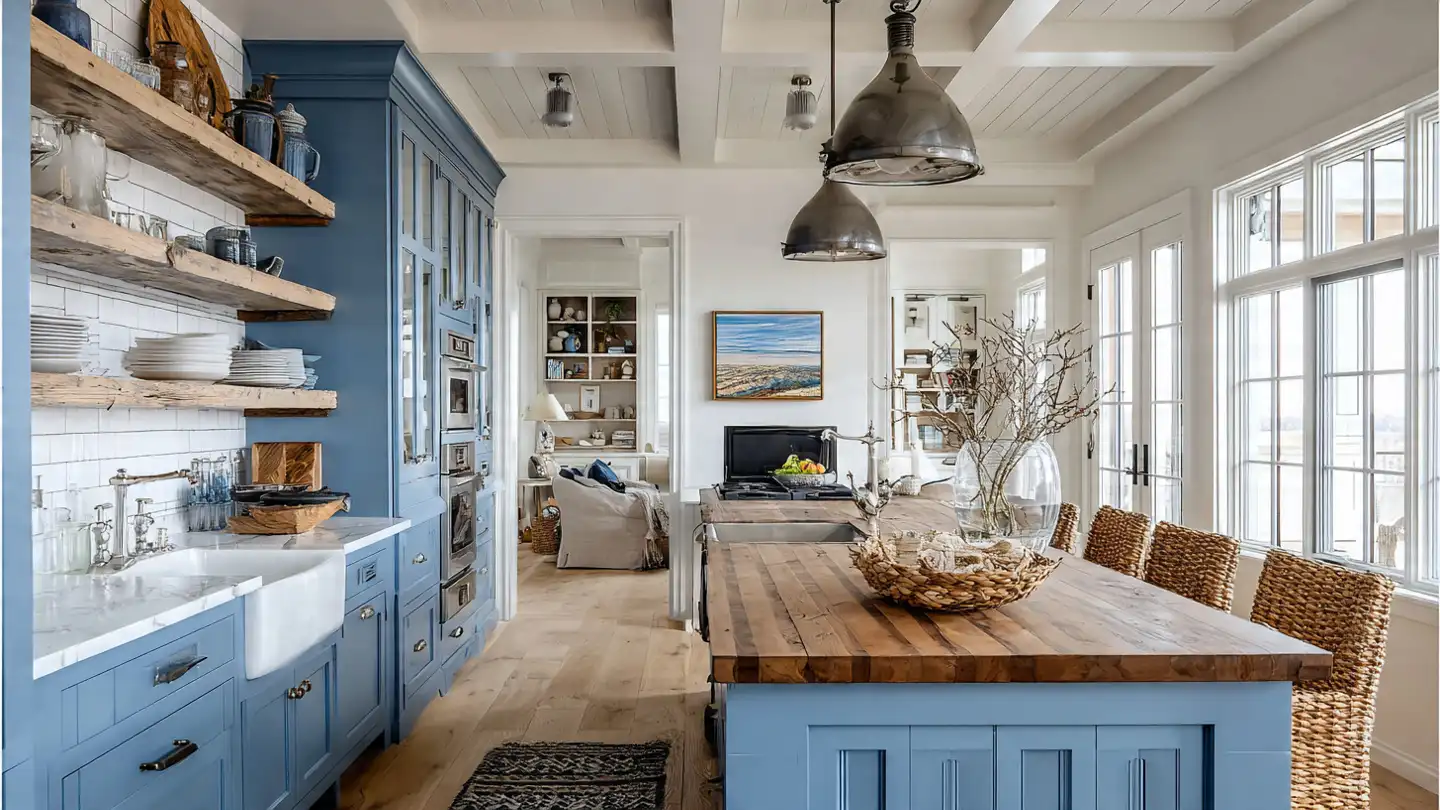
- Rich, desaturated blues that feel borrowed from Delft pottery or Farrow & Ball’s historical archives
The key is complexity. Flat, single-note colors read as artificial. Colors with depth—what painters call “dirty” colors—feel lived-in from day one.
For country kitchens specifically, the best colors honor the architecture’s context. A kitchen in New England can carry stronger, more saturated colors than one in the Southwest because the quality of light differs dramatically. The mistake is choosing a color from a national magazine without testing it in your actual space, at multiple times of day, against your actual floors and countertops.
Countertops That Actually Work for Country Style

The era of Carrara marble as default is ending. Not because marble is wrong for country kitchens—it can be perfect—but because the specific white-gray veining became so ubiquitous that it lost meaning.
For authentic country character, I’m specifying:
Honed or leathered granite in deeper tones. Not the polished, speckled patterns of the 1990s, but materials like Uba Tuba or Steel Gray with matte finishes. They read as stone, not as surface. They forgive daily use.
Soapstone for clients who want the patina conversation. It scratches. It darkens unevenly. It requires maintenance. These aren’t flaws—they’re the point. A soapstone countertop records your kitchen’s actual history.
Butcher block in specific applications. Not as the primary surface (the maintenance burden is real), but for islands, baking stations, or dedicated prep areas. IKEA’s oak counters, properly oiled and cared for, develop character that no manufactured material can replicate.
Quartzite for clients who want marble’s look without its porosity. The material costs more, but Taj Mahal or Sea Pearl quartzites offer movement and warmth that engineered quartz increasingly lacks.
The mistake I see constantly: choosing countertops for photography rather than for use. That super-white quartz with dramatic veining? It shows every crumb, every water spot, every moment of actual life. Country kitchens should invite use, not document it for social media.
Layout Rules That Actually Matter

Design magazines love the kitchen triangle—the imaginary lines connecting sink, stove, and refrigerator. The concept dates to the 1940s, when kitchens were smaller, appliances were smaller, and multiple cooks were rare.
It’s not wrong. It’s just insufficient.
What replaces it is zoned workflow design. The question isn’t whether your three main appliances form a triangle. It’s whether your kitchen supports how you actually work.
The 3×4 Kitchen Rule (sometimes called the 3-4-5 rule in different contexts) refers to minimum clearances: 36 inches minimum for single-cook walkways, 48 inches for passing or multiple cooks. But this is just the beginning. The real insight is designing distinct zones—prep, cooking, cleaning, storage, serving—each with appropriate space and adjacencies.
I redesigned a kitchen last year where the refrigerator was perfectly positioned by triangle standards. But the homeowners never used it as designed. One partner cooked; the other managed kids’ snacks and homework. The fridge became a traffic magnet, a gathering point that disrupted every workflow. We moved it to the kitchen’s edge, created a dedicated snack zone with a small secondary refrigerator, and the main kitchen finally functioned.
The Golden Rule of Kitchen Design isn’t geometric. It’s experiential: You should be able to complete any common task without crossing your own path more than once. This sounds simple. It requires ruthless analysis of actual behavior.
For refrigerator placement specifically, the old rule said it should anchor the triangle’s short leg. The better rule: position it for access without entering the main work zone. This often means the refrigerator lives at the kitchen’s perimeter, not its center. The National Kitchen and Bath Association guidelines suggest 15 inches of landing space on the handle side. I’d argue for more—18 to 24 inches—if you actually unpack groceries in your kitchen rather than your garage.
The 1/3 Rule for Cabinets addresses visual balance: upper cabinets should occupy roughly one-third of your vertical wall space, with two-thirds below (including countertops and base cabinets). This prevents the top-heavy, institutional look of kitchens with excessive wall cabinets. It also acknowledges that most people can’t reach the top shelves anyway.
The 60-30-10 Rule (borrowed from general interior design) applies to kitchen color distribution: 60% dominant color (usually cabinets and walls), 30% secondary (countertops, flooring, large appliances), 10% accent (hardware, lighting, accessories). The mistake is treating this as rigid formula rather than diagnostic tool. If your kitchen feels chaotic, check your ratios. If it feels flat, your 10% accent might need amplification.
The 5 C’s and Other Functional Frameworks

Kitchen designers love acronyms. The 5 C’s of Kitchen Design—convenience, comfort, capacity, compatibility, and cleanliness—sound like corporate training material. But they map to real decisions.
Convenience is about reducing motion. The Spaulding Rehabilitation Hospital kitchen studies found that poor layout adds hundreds of unnecessary steps daily. For aging-in-place design, this becomes critical. For everyone, it reduces fatigue.
Comfort encompasses physical ergonomics (counter heights, reach ranges) and psychological comfort (natural light, sight lines to other spaces, acoustic control). The most beautiful kitchen fails if conversation requires shouting over appliances.
Capacity isn’t just storage volume. It’s storage appropriateness—having the right kind of space for what you actually own. The Container Store’s organizational systems matter less than honest assessment of your cooking habits.
Compatibility addresses how the kitchen relates to adjacent spaces. Open plans require different solutions than enclosed kitchens. A kitchen that ignores its context feels orphaned.
Cleanliness involves material selection and maintenance design. Some beautiful materials demand constant attention. Others forgive neglect. Neither is wrong, but mismatching material to lifestyle creates resentment.
These frameworks matter because they shift focus from appearance to experience. A kitchen can photograph beautifully and function terribly. The 5 C’s help prevent this.
Common Mistakes in Country and Rustic Design

I’ve walked through hundreds of kitchens where the intent was “warm and rustic” and the result was “confused and cheap.” The patterns are consistent.
Mistake One: Decorative rusticity. Corbels that support nothing. Beams that are clearly hollow boxes. “Reclaimed” wood with uniform distressing. These elements signal inauthenticity immediately. If you want exposed structure, expose actual structure. If you want aged wood, use actually old wood or accept that new wood will age in real time.
Mistake Two: Scale confusion. Farmhouse sinks are beautiful, but a 36-inch apron sink in a compact kitchen dominates disproportionately. Heavy timber beams in rooms with 8-foot ceilings feel oppressive. Country style requires proportion appropriate to architecture.
Mistake Three: Pattern overload. The farmhouse formula encouraged mixing: buffalo check, grain sack stripes, floral motifs, script typography. The result was visual noise. Effective country kitchens limit pattern and let material texture provide interest.
Mistake Four: Ignoring regional context. A Tuscan-inspired kitchen in a Pacific Northwest craftsman house feels displaced. Country style should derive from local building traditions, available materials, and environmental conditions.
Mistake Five: The “set dressing” approach. Decorative ladders, vintage signs, ceramic roosters, mason jar storage for items never preserved. These objects perform rusticity without participating in it. The cure is using actual functional objects with actual history.
I worked with a couple in Maine whose “country kitchen” felt like a theme restaurant. We removed seventeen decorative items. We displayed her grandmother’s mixing bowls, his fishing tackle box repurposed for utensil storage, their actual children’s artwork. The kitchen became specific to them. Visitors commented on its warmth without identifying any single change.
The Modern Farmhouse vs. Country Kitchen Distinction

These terms get used interchangeably, but they describe different approaches.
Modern Farmhouse is a specific aesthetic movement: white or light neutrals, black accents, clean lines mixed with rustic references, industrial lighting, open shelving with curated displays. It’s designed, edited, photographed. It peaked around 2018-2020 and is now experiencing significant backlash.
Country Kitchen is broader and older—a category encompassing regional traditions from English cottages to American farmsteads to Provençal farmhouses. The common elements are practicality, material honesty, and connection to place. Country kitchens can be dark or light, simple or layered, depending on their specific tradition.
The confusion arose because Modern Farmhouse borrowed selectively from country kitchen elements while stripping away their specificity. The result was a style that referenced “country” without committing to any actual country.
20 Bedroom Storage Ideas That Actually Create Space
For 2026, the distinction matters again. Homeowners are choosing between continuing the Modern Farmhouse evolution (now often called Transitional Farmhouse or Organic Modern) or returning to more rooted country traditions.
French Country specifically—distinct from general country style—combines rustic materials with refined proportions and decorative detail. It draws from 18th-century French provincial furniture and architecture, with curved lines, painted finishes, and natural motifs. It’s more formal than American farmhouse traditions, more ornate than Belgian or Scandinavian approaches.
Making Modern Feel Country: Practical Transformation

Not everyone starts fresh. Many homeowners inherit modern kitchens—sleek cabinets, minimal detail, perhaps some regrettable 2010s choices—and want warmth without complete renovation.
The budget approach focuses on surface and accessory changes:
- Replace hardware with unlacquered brass or hand-forged iron
- Add a freestanding furniture piece (hutch, work table, open shelving unit)
- Introduce natural textiles: linen curtains, wool rugs, cotton towels with visible weave
- Display functional objects with patina: copper pots, wooden bowls, ceramic crocks
- Change lighting to something with material presence: rattan, aged metal, hand-blown glass
The moderate investment might include:
- Painting cabinets in a complex, warm color
- Replacing countertops with something more organic
- Adding a backsplash with handmade character: zellige tile, hand-painted ceramic, or natural stone with variation
The significant but non-gut renovation could involve:
- Replacing upper cabinets with open shelving or individual cabinets that read as furniture
- Installing a statement range hood with material presence
- Adding architectural detail: plate rail, wainscoting, or ceiling beams that reference actual structure
The principle throughout: country character comes from material, proportion, and accumulation over time. It cannot be installed in a weekend. But it can be begun.
Layout Mistakes That Destroy Function

Beyond aesthetic choices, specific layout errors recur constantly:
The refrigerator as obstacle. Positioned for the triangle, blocking circulation, creating congestion. Solution: perimeter placement with dedicated landing space, or integrated paneling that reduces visual impact.
The island as barrier. Too large for the surrounding clearance, forcing awkward circulation, preventing conversation across it. The National Kitchen and Bath Association recommends 36 inches minimum on all sides; I’d suggest 42-48 inches if the island includes seating.
The microwave placement problem. Above the range (awkward access, poor ventilation), in the island (bending, splatter), or hidden in a cabinet (forgotten, inconvenient). The best solutions integrate microwaves at counter height in secondary locations, or abandon them for speed ovens or simple stovetop reheating.
The missing landing space. Every major appliance needs adjacent surface. The guidelines specify 15 inches beside refrigerators and ovens, 18 beside sinks. In practice, more is better. The most functional kitchens I’ve designed exceeded these minimums significantly.
The storage-distance problem. Frequently used items stored inconveniently. Daily dishes in upper cabinets requiring reaching. Pots and pans distant from the range. The solution is mapping actual use patterns before finalizing storage design.
What Never Actually Goes Out of Style

Amid trend cycles, certain kitchen characteristics persist:
Natural materials that age gracefully. Wood, stone, metal in finishes that show wear as character rather than damage. The opposite: materials that look pristine or deteriorate badly.
Proportion appropriate to architecture. Kitchens that respect their container, whether grand or modest. The opposite: kitchens that impose a scale inappropriate to their setting.
Workflow based on actual behavior. Layouts that accommodate how specific people actually cook, not theoretical optimal patterns. The opposite: kitchens designed for imaginary users.
Light quality. Multiple sources, natural where possible, with attention to color temperature and dimming capability. The opposite: uniform overhead lighting that flattens everything.
Adaptability. Spaces that can evolve with changing needs, technologies, and tastes. The opposite: highly specialized designs that resist modification.
These principles don’t generate magazine headlines. They generate kitchens that satisfy over decades.
The Joanna Gaines Question

No discussion of farmhouse style can avoid this. Joanna Gaines and Chip Gaines built Magnolia into a lifestyle empire. Their aesthetic—shiplap, neutral palettes, vintage-industrial accents—defined an era.
Is she “out of style”? The question misunderstands how influence works. The specific formula Gaines popularized has indeed saturated and exhausted itself. But her deeper insight—that homes should tell stories, that renovation can be emotional transformation rather than mere improvement—continues to resonate.
What evolved is the story being told. The Gaines-era story was about restoration, about finding beauty in overlooked places, about democratic access to design confidence. The emerging story is about specificity, about resisting mass production, about building coherence over time rather than installing it completely.
Gaines herself has evolved. Recent Magnolia content shows more variation, more color, more acknowledgment of different regional and personal expressions. The brand isn’t static. Neither is the desire for homes that feel meaningful.
The risk is conflating the person with the aesthetic. Disliking overexposed shiplap doesn’t require dismissing the entire project of thoughtful home-making.
Looking Forward: 2026 and Beyond

Specific predictions are foolish. But directional observations are possible:
Material innovation will continue. Sintered stone, advanced ceramics, and bio-based materials will offer new options for countertops and surfaces. The winners will be those that combine performance with aesthetic warmth.
Appliance integration will deepen. Refrigerators that disappear into cabinetry. Cooking surfaces that retract. The kitchen as flexible space rather than fixed installation.
Sustainability will shift from marketing claim to design driver. Not just energy efficiency, but material sourcing, longevity, adaptability. Kitchens designed for disassembly and reuse.
The personalization imperative will intensify. The backlash against mass-produced aesthetics will extend to custom fabrication, local craft, and owner participation in making.
What won’t change: the kitchen’s role as domestic center. The need for spaces that support nourishment in all senses—physical, social, emotional. The value of design that respects actual human behavior rather than imposing idealized patterns.
Your Specific Situation
If you’ve read this far, you’re likely considering your own kitchen. Some diagnostic questions:
- What do you actually do in your kitchen? Not what you aspire to do, but the daily reality.
- What frustrates you currently? Specific moments of annoyance reveal design failures.
- What do you love in other kitchens? Not magazine images, but spaces where you’ve felt genuinely comfortable.
- What’s your timeline? Country character develops over years. If you need immediate satisfaction, different approaches may serve better.
- What’s your tolerance for maintenance? Some beautiful materials demand attention. Others forgive neglect.
The best kitchen I designed last year started with the client’s grandmother’s flour sifter. We built everything around that object—its scale, its material, its evidence of use. The result wouldn’t work for anyone else. For her, it’s irreplaceable.
That’s the standard. Not trend compliance. Not resale optimization. The kitchen that recognizes and supports your specific life.


